

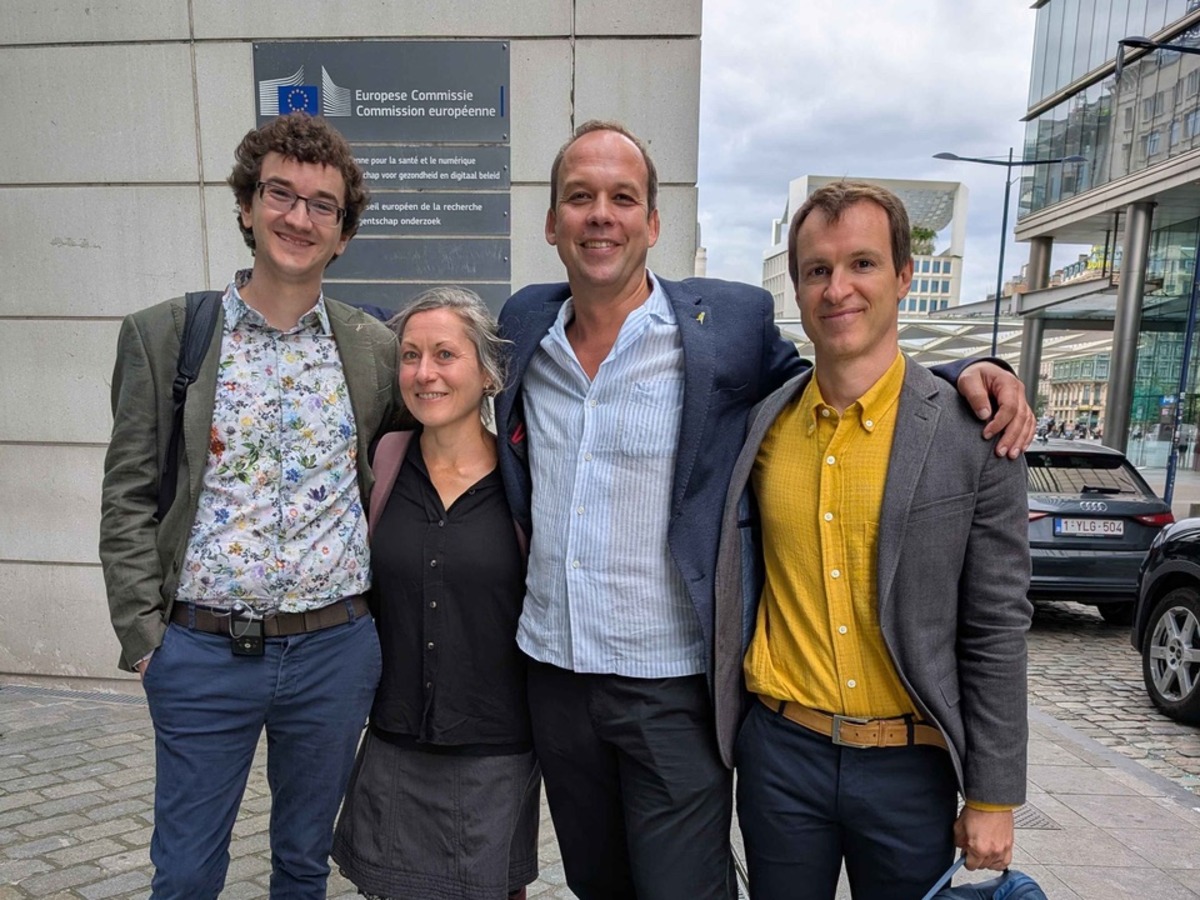
INTREEG (“Integrating interactions into phylogenetics to reconstruct genome and biosphere evolution”), a project of four groups led by Anja Spang (NIOZ, Texel, corresponding PI), Tom A. Williams (University of Bath), Bastien Boussau (CNRS, LBBE, Lyon) and Gergely Szöllősi (OIST, Okinawa, and the Institute of Evolution of the HUN-REN Centre for Ecological Research, Budapest), has been selected for funding in the ERC’s 2026 Synergy Grant call. The grant is hosted at OIST, which is possible because a Synergy Grant allows one of its two to four PIs to be based outside the EU and the associated countries, and it is the first ERC grant at OIST.
The project runs for six years with a budget of about EUR 7.8 million, of which about EUR 1.4 million at OIST.
INTREEG asks how far back the history of life can be reconstructed from the genomes of living organisms, and what the microbes along the way were like, i.e. their genomes, metabolisms and environments. Today this phylogenetic horizon lies at the last universal common ancestor (LUCA), over four billion years ago, and the models used to get there are tractable only because they assume that sites in a protein, genes in a genome and species in a community evolve independently, which they do not. Interactions are not only biology we leave out, they are also information we leave untapped: the four groups will use machine learning to learn interactions from hundreds of thousands of genomes and build them into the models, to push the horizon back beyond LUCA, into the period in which the core components of the cell arose (many gene families are older than LUCA and survive as several copies in every genome), and to recover the “ghost” lineages that left no descendants but whose genes survive, through transfer, in those that did.
The OIST team (a senior bioinformatician and two postdocs) will develop the interaction-aware methods and the reconstructions of microbial communities through time, and coordinate the project’s software and data infrastructure.
Gergely Szöllősi: “The genomes of living organisms are a record of the history of life, but today we can read it back only as far as LUCA, the last universal common ancestor, over four billion years ago. The models that get us there are tractable only because they assume that sites in a protein, genes in a genome and species in a community evolve independently, which they do not. Interactions are not just biology we leave out, they are information we leave untapped. With hundreds of thousands of genomes and machine learning we can finally learn them from the data, and the question is how much further back they let us see, including the lineages that left no descendants but whose genes survive in ours. The OIST team will build these methods, and the software and data infrastructure the four groups share.”
Photo, from left to right: Tom A. Williams, Anja Spang, Gergely Szöllősi, Bastien Boussau, after the interview.