

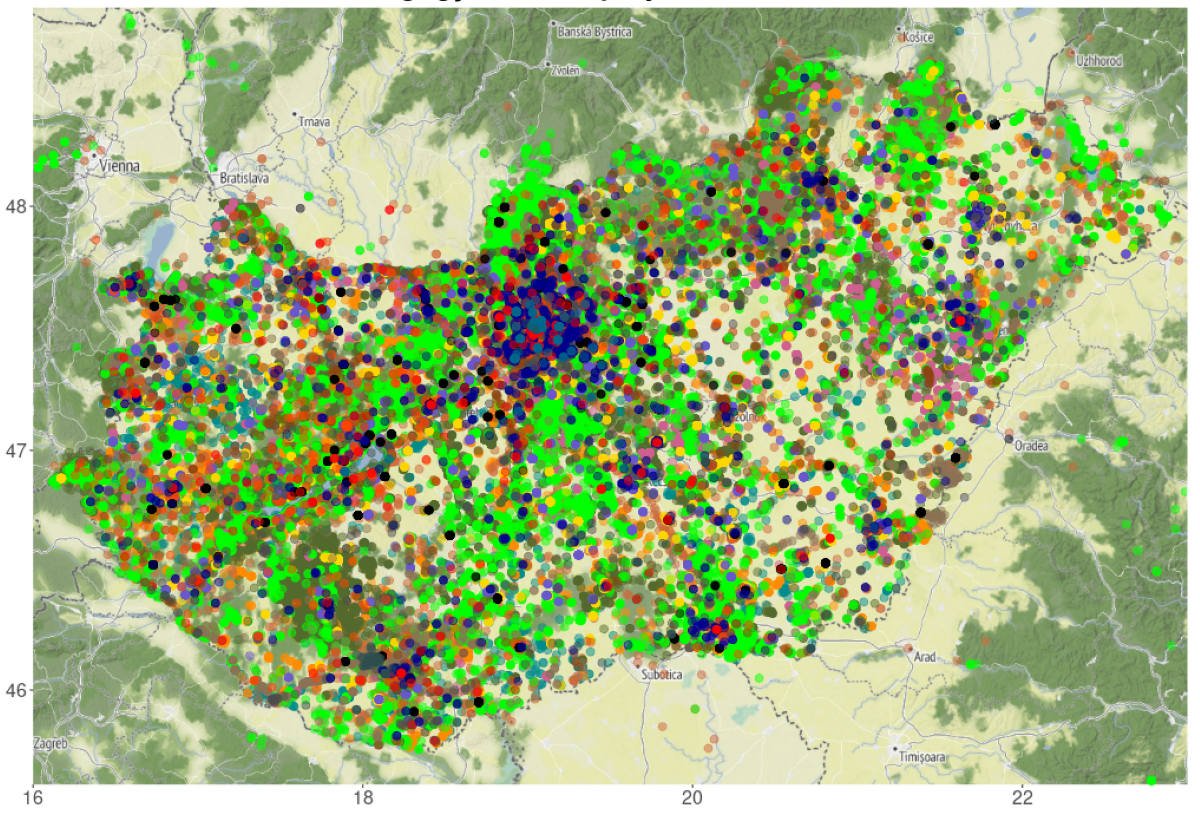
Citizen science projects are playing an increasingly important role in ecological and conservation research worldwide. In these programs, members of the public support researchers by submitting photographs, audio recordings, observations, or even by contributing to data analysis. In Hungary, no fewer than 17 such initiatives combined their datasets in a joint study.
The authors aimed to understand which socio-economic and environmental factors influence participation patterns in Hungary. By comparing the spatial distribution of citizen science data with an independent administrative dataset (municipality level data on income, education, demography, density and protected areas), the researchers identified several general trends as well as numerous project-specific relationships.
For example, they found more per capita observations from municipalities with higher proportions of protected natural areas and lower population densities. Furthermore, excluding Budapest, the capital, both the proportion of people with diplomas and the proportion of elderly people showed a positive correlation with participation activity. In contrast, no consistent general pattern emerged regarding wealth or the proportion of children, although several project-specific relationships were observed.
The study not only reveals how citizen science data are distributed across Hungary, but also provides robust support for the view that various biases must be taken into account when analyzing such data. The authors hope that their findings will help researchers in other countries design more effective projects and produce more accurate analyses by accounting for some of these or similar biases.
In recent years, citizen science methodology has gained significant momentum and is becoming increasingly important in large-scale ecological and conservation research. By involving volunteers, it enables a level of spatial and temporal coverage that would often be unattainable within traditional research frameworks. However, the method also comes with specific challenges. One of the main criticisms of citizen science data is that observation density can vary substantially across space and time, making direct comparisons with systematically collected datasets difficult. These patterns may partly reflect real biological differences, for example, in the case of species that occur seasonally or in patches, but they are also strongly influenced by the distribution and behaviour of volunteers.
To address this issue, a research team led by the HUN-REN Centre for Ecological Research applied a novel approach. They compared a database of more than 300,000 citizen science observations with regional data from the Hungarian Central Statistical Office (HCSO) at the municipality level. The citizen science data included projects focusing on arthropods, molluscs, reptiles, birds, mammals, but also on streams and ponds. In simple terms, they examined whether the characteristics of local populations and environments systematically influence the number of submitted observations. One of the key strengths of this approach is that it combines two independent data sources: citizen science data reflect volunteer activity, while HCSO data describe socio-economic and environmental background variables. This independence helps to avoid biases commonly associated with survey-based studies. The applied meta-analysis allowed the identification of both project-specific and general patterns, making the results applicable at multiple levels.
The analysis shows that participation is not random. A positive relationship was found between participation and the proportion of protected areas: in general, municipalities with higher proportions of protected areas receive more observations. Population density shows a more complex pattern: in general analyses, it was negatively associated with participation, but when Budapest was excluded (due to its exceptionally high density and other unique characteristics) the effect disappeared. In this adjusted analysis, the proportion of people with a diploma and the proportion of elderly residents both showed positive correlations with participation.
The study also identified finer-scale patterns. For example, citizen science projects that involve observations in private gardens showed a significant positive relationship with the proportion of children, a pattern not observed in other types of projects. Another interesting finding was that projects focusing on specific habitats tended to receive more observations from municipalities with lower levels of education and income, which may be linked to lower levels of urbanization. At the same time, it is important to interpret these results within their specific context. Participation patterns are influenced by many factors, including the research topic, the effectiveness of communication, and the institutional and social background of each project.
Overall, as the leading author Zsóka Vásárhelyi argues: “the majority of citizen science data are very likely biased”; however, they remain extremely valuable, as long as researchers consciously account for their biases during project design, data collection, analysis, and interpretation.
Publication:
Zsóka Vásárhelyi, Barbara Barta, Marianna Biró, Zoltán Csabai, Gábor Földvári, Bálint Halpern, Zsófia Horváth, Erika Juhász, Balázs Károlyi, Kornélia Kurucz, Zsuzsanna Márton, László Mezőfi, Péter Lovászi, Barna Páll-Gergely, Bálint Pernecker, Ádám Selmeczi-Kovács, Zoltán Soltész, Éva Szabó, Ágnes Turóci, Vadonleső Group, Judit Vörös, László Zsolt Garamszegi :
Environmental and socio-economic factors behind data provision in 17 citizen science projects